
BCAA Case Study - Meridian Financial 2025
By Dr. Raymond Friedman – November 24, 2025
When Human Behavior Breaks Security:
The $2.4M Breach That Every Leader Should Learn From & Why Behavioral Compliance, Not Technology, Is Now the #1 Factor in Cybersecurity Resilience
Why Behavioral Compliance, Not Technology, Is Now the #1 Factor in Cybersecurity Resilience.
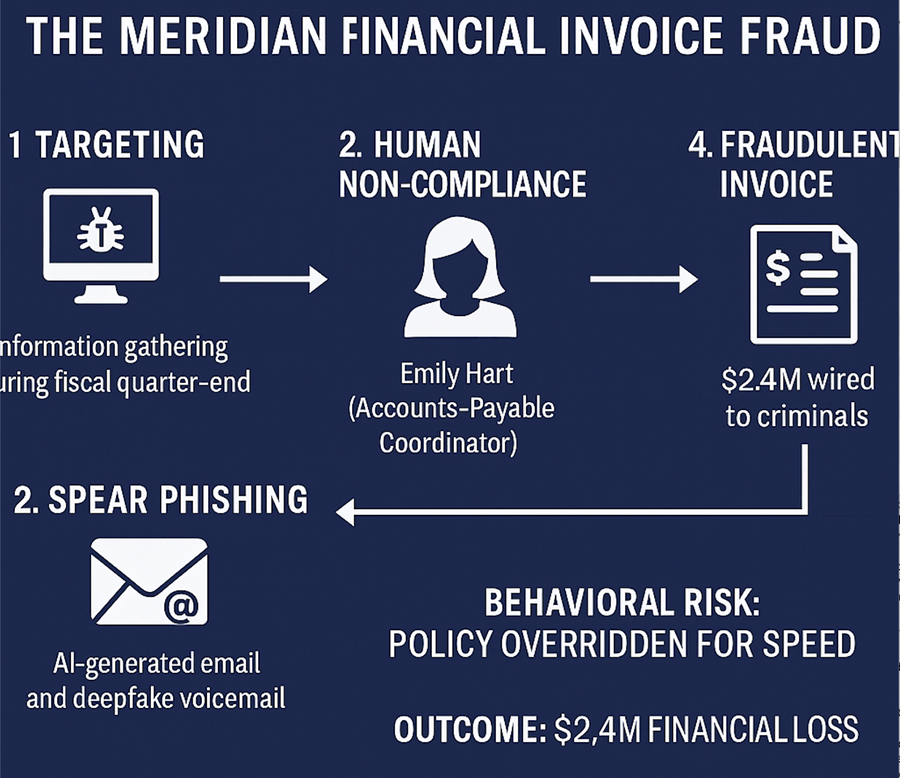
In March 2025, a company, for anonymity, identified as Meridian Financial Services (MFS) — a mid-sized lending and wealth management firm — experienced a catastrophic $2.4 million invoice redirection breach.
The attackers employed advanced AI-driven deception, domain spoofing, and voice cloning to execute a nearly flawless attempt at fraud. But the breach didn’t succeed because their tools/polices failed. It succeeded because an employee bypassed a single internal control. A mandatory verification step — ignored. A compliance reminder — dismissed. An attacker requests — trusted. This pattern is shockingly common.
The Hidden Crisis: 88% of Cyber Incidents Are Caused by Human Behavior
Global studies reveal what most executives don’t want to admit:
- 88% of breaches involve human error or policy non-adherence (Stanford/IBM).
- 78% of employees routinely disregard security policies because they’re “inconvenient” (HP Wolf Security).
- 62% of organizations say their most significant threat is “employees not following procedures.” (Tessian, 2024)
- 76% of ransomware intrusions begin with an employee bypassing a required control. (CISA)
Organizations continue to invest in better firewalls, zero-trust tools, and AI monitoring — yet they lack visibility into the behavioral readiness of their own workforce. This is precisely why Meridian fell. Because internal controls only work if people do.
The Real Cause of Meridian’s $2.4M Loss
A senior accounts payable coordinator, for anonymity, is referenced as Emily Hart, and received what appeared to be a standard vendor update request. She:
- Ignored the mandatory out-of-band verification
- Forwarded the request without validation
- Skipped 11 compliance prompts in the prior month
- Believed the process was “administrative, not security critical”
And just like that, $2.4M was transferred to a fraudulent overseas account. This wasn’t a zero-day exploit. It wasn’t a system misconfiguration. It wasn’t a failed tool. It was behavioral non-compliance — the most predictable cyber vulnerability.
What the BCAA™ Revealed
After the breach, Meridian implemented the Behavioral Compliance Aptitude Assessment (BCAA™). The results were startling:
Department BCAA Averages Across 312 Employees:
- Organizational Culture: 67% (Moderate Risk)
- Employee Adherence: 49% (High Risk)
- Ethical Beliefs: 53% (High Risk)**
Emily’s individual scores:
- 44% Adherence
- 51% Ethical Beliefs
- 48% Cultural Alignment
These scores placed her directly into the Compliance Risk Zone — meaning her behavioral profile already aligned with known patterns of policy bypass, shortcut-taking, and procedural drift. In other words: This breach was predictable. And preventable.
Why Behavior Is Now the #1 Cyber Risk
Organizations have perfected detection, automation, access controls, and monitoring…But none of that prevents an employee from:
- clicking a malicious link
- skipping a verification
- bypassing access procedures
- using an unapproved tool
- ignoring a mandatory
- compliance step
Behavioral vulnerabilities are now the primary attack vector. Attackers know this, too. AI Is Rapidly Scaling Human-Focused Attack Strategies
Recent threat data shows:
- Deepfake fraud has increased by 700% in the past 18 months.
- AI-generated spear phishing has a 53% higher success rate than human-written phishing (SlashNext, 2024).
- Threat actors now use agentic AI to automate social engineering across time zones, languages, and personas.
- Voice cloning can be achieved with just 3 seconds of audio.
AI isn’t attacking our firewalls. AI is attacking organizational staff. And unless organizations measure, correct, and reinforce employee behavior, breaches like Meridian’s will continue to rise — regardless of the level of security spending.
What is mile2’s BCAA™, and what makes it Essential for organizations
The Behavioral Compliance Aptitude Assessment (BCAA™) is a scientifically designed instrument that measures the human factors behind cybersecurity and compliance risk. Instead of evaluating technical skill, the BCAA™ analyzes organizational culture alignment, employee adherence behaviors, and ethical decision-making—the three dimensions most strongly linked to policy violations and control failures. By identifying individuals and teams with elevated behavioral risk, the BCAA™ provides organizations with early insight into who is most vulnerable to shortcuts, social engineering, and non-compliant actions, enabling targeted training, supervision, and governance before a breach occurs. The BCAA™ is the first behavioral analytics instrument explicitly designed for:
- compliance alignment
- ethical decision-making
- cultural readiness
- internal control adherence
- human vulnerability prediction
The BCAA™ transforms “soft factors” into measurable, actionable risk intelligence.
With the BCAA™, organizations can:
- Identify high-risk employees before an incident
- Pinpoint departments with weakened compliance culture
- Detect behavioral drift under pressure
- Target retraining exactly where needed
- Tie ethics and compliance to performance
- Reinforce internal controls with behavioral data
- Reduce audit and regulatory exposure
And perhaps most importantly, it quantifies the human attack surface — the part of cybersecurity that no technology can patch.
The Financial Reality No Board Can Ignore
Industrywide data shows:
- The average cost of a behavior-driven breach is $ 3.1 million.
- Human error increases the likelihood of a breach by 85%.
- Employees in high-pressure roles bypass controls 2.7× more often.
- Seventy-five (75)% of companies cannot measure their workforce’s compliance readiness.
The cost of employee non-adherence is now greater than the cost of ransomware. Meridian learned this the hard way.
Conclusion: You Cannot Secure What You Cannot Measure
Meridian Financial did not lack tools, funding, or policies; what they lacked was visibility into behavior. The BCAA™ provides what every organization needs: An early warning system for behavioral cybersecurity risk.
The breach Meridian suffered could have been prevented months in advance — had the organization known who was most likely to bypass controls, why it was happening, and where cultural weaknesses existed. In an AI-driven threat landscape, behavior is the new perimeter — and the BCAA™ is the only instrument that measures it.
References
Cybersecurity and Infrastructure Security Agency. (2024). Ransomware Vulnerability Warning Pilot: Key findings report. CISA. https://www.cisa.gov/resources-tools/resources/ransomware
HP Wolf Security. (2023). Blurring boundaries & blind spots report. HP Development Company. https://www.hp.com/us-en/security/enterprise-security/wolf-security.html
Tessian. (2024). The state of data loss report. Tessian Cybersecurity Research. https://www.tessian.com/resources/state-of-data-loss-report/
Tessian, & Stanford University. (2022). The psychology of human error. Tessian Research. https://www.tessian.com/research/the-psychology-of-human-error/
SlashNext. (2024). 2024 Phishing intelligence report: The rise of AI-powered credential theft and business email compromise. SlashNext Cybersecurity.https://www.slashnext.com