
AI Misuse and Cybersecurity Ethics
by Raymond Friedman, PhD – November 14, 2025
The integration of artificial intelligence into cybersecurity was meant to accelerate detection, automate response, and minimize human error. Yet, as of 2025, the same technology designed to defend is increasingly being weaponized — a paradox where AI has become both the shield and the sword.
1. The Rising Threat Landscape
In the last 18 months alone, AI-related cyberattacks have surged by over 600% globally, according to the World Economic Forum’s Global Cybersecurity Outlook 2025. This escalation is not limited to nation-state adversaries — 42% of AI-powered breaches were linked to organized cybercriminals operating inside national borders.
Key findings reveal alarming trends:
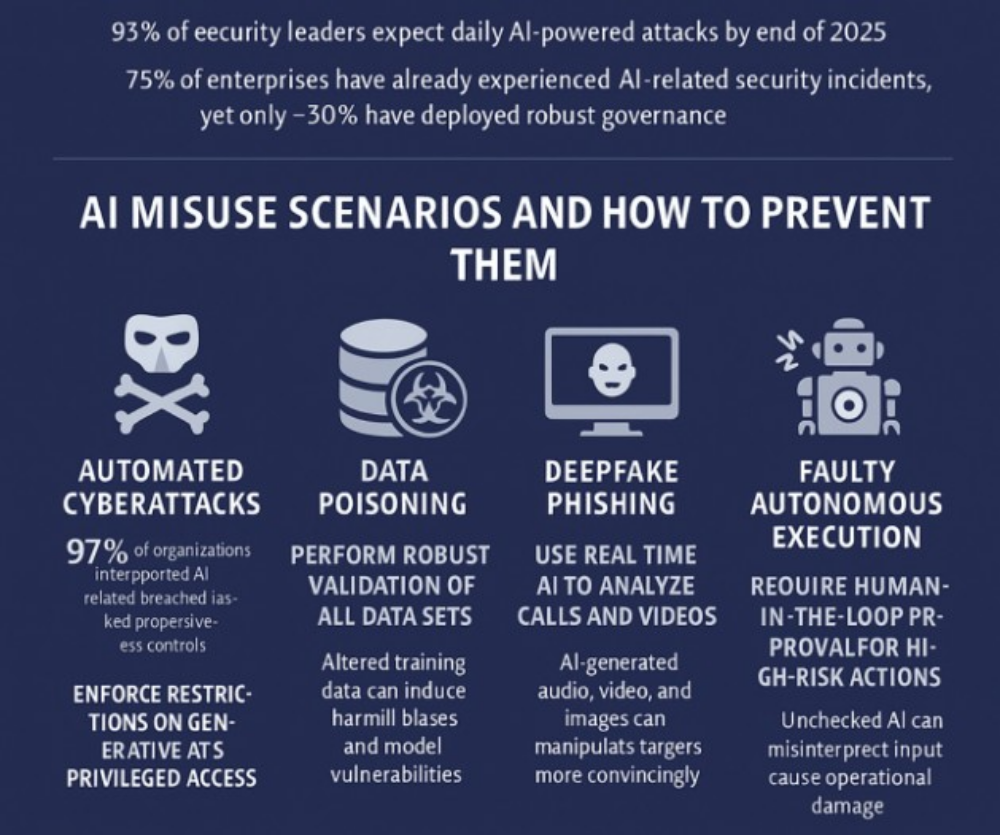
- By the end of 2025, 93% of security leaders expect to face daily AI-powered attacks (Trend Micro, 2025).
- 75% of enterprises have already faced an AI-related incident, ranging from data poisoning to automated phishing (SecureWorld, 2025).
- 97% of organizations that suffered an AI-related breach lacked mature access or privilege controls (IBM Cost of a Data Breach Report, 2025).
- Global financial losses attributed to AI-enabled cybercrime are projected to exceed $1.5 trillion by 2026, representing a 320% increase over 2022.
2. Methodologies Behind AI Misuse
AI misuse in cybersecurity follows a structured, often industrialized methodology. Attackers have evolved from experimentation to systematized workflows that mimic legitimate AI development cycles.
3. Data Poisoning and Model Manipulation
Attackers corrupt AI models by injecting manipulated training data. This tactic undermines integrity and biases decision-making algorithms — especially in fraud detection, intrusion prevention, and identity verification systems.
Methodology:
- Insert false positives or misclassified samples during supervised learning.
- Exploit open-source model repositories with poisoned datasets.
- Influence retraining cycles by continuously manipulating data drift.
Mitigation: Deploy data provenance frameworks and cryptographic validation of training inputs (e.g., IEEE 7002 and NIST SP 1270 recommendations).
4. Balanced Difficulty: Deep Technical Skill Without Gatekeeping:
Some certifications, such as OSCP, are intentionally grueling — rewarding only those who can dedicate 200+ hours to a single exploit exam. While it’s respected, it’s not practical for every enterprise environment.
C)PTE bridges the gap between academic theory and real-world performance. It challenges candidates technically, but with precise methodology, structured instruction, and achievable mastery for professionals who also hold operational responsibilities.
In contrast:
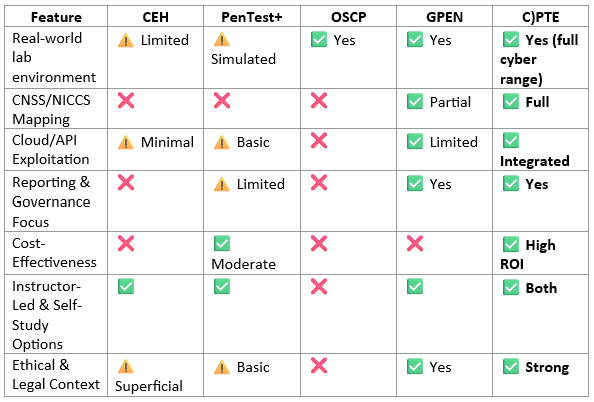
- CEH – Outdated tool lists and limited practical assessment.
- PenTest+ – Broad coverage, minimal realism.
- OSCP – Deep exploitation, limited governance context.
- GPEN – Strong theory, but premium cost and limited accessibility.
5. Designed for ROI and Relevance:
Cybersecurity budgets are under pressure, and certifications must demonstrate their value and justify their cost. C)PTE is more affordable than its competitors — typically half the price of CEH and a fraction of GPEN or OSCP — but with a higher return on skill applicability. Where others sell a brand, Mile2 delivers a product:
- Up-to-date labs aligned with real adversarial techniques.
- Annual content revisions based on CISA KEV, NIST SP 800-115, and MITRE mappings.
- Instructor-led options and online range access included — no hidden membership
6. Trusted by Governments, Corporations, and Academia:
Mile2 is a trusted training provider for defense contractors, federal agencies, and Fortune 500 organizations. Its C)PTE certification is not designed for marketing appeal — it’s built for mission assurance.
Universities integrate it into degree programs; private enterprises use it for red-team readiness; government agencies rely on it for workforce compliance mapping.
“C)PTE doesn’t just teach penetration testing — it builds ethical engineers who understand their responsibility to protect what they can break.” — Dr. Raymond Friedman, President, Mile2®.
7. The Professional’s Choice:
If CEH is the awareness badge, PenTest+ is the entry ticket, and OSCP is the individual challenge, C)PTE is the professional standard. It’s where capability, credibility, and conscience converge. Organizations serious about testing their systems — and developing professionals capable of defending them — consistently find that C)PTE produces measurable results, not just certificates on a wall.
In Summary: Why C)PTE Stands Apart from the Others
Final Word:
C)PTE represents the evolution of professional credibility in cybersecurity.
It bridges the gap between knowledge and execution, aligning deep technical skill with the moral responsibility of defense. Ultimately, mile2’s C)PTE delivers measurable performance, ethical grounding, and the assurance that when it’s time to act, skill meets responsibility.