
How to Become a Penetration Tester:
A Step-by-Step Career Roadmap
By Dr. Raymond Friedman, President, Mile2
Introduction
Penetration testing is one of the most exciting and practical career paths in cybersecurity. A penetration tester, often called a penetration tester (pen tester/pentester) or ethical hacker, is hired to legally test systems, networks, cloud environments, applications, and organizations for weaknesses before real attackers can exploit them.
For many people entering cybersecurity, penetration testing feels like the “hands-on” side of the field. It involves reconnaissance, vulnerability discovery, exploitation validation, reporting, and helping organizations improve their defenses. But becoming a professional pentester is not simply about learning tools. It requires technical skill, ethical judgment, structured methodology, communication ability, and a clear understanding of legal boundaries.
The demand for cybersecurity professionals remains strong. The U.S. Bureau of Labor Statistics projects employment for information security analysts to grow 29 percent from 2024 to 2034, much faster than the average for all occupations. The same source projects about 16,000 openings per year in that category over the decade. While penetration testing is only one part of the broader cybersecurity field, this growth reflects the continuing need for professionals who can help organizations identify and reduce cyber risk.
This guide explains how to become a penetration tester, what skills to build first, which certifications can help, and how Mile2® certifications, such as C)PEH, C)PTE, and CAICSO™, can support your career path.
What Does a Penetration Tester Do?
A penetration tester evaluates an organization’s security by thinking like an attacker while operating under legal authorization. The goal is not to “break in” for its own sake. The goal is to identify weaknesses, demonstrate real-world risk, and provide actionable recommendations to improve the organization’s security posture.
A professional penetration test may include:
- Reconnaissance and attack surface mapping
- Network and service enumeration
- Vulnerability identification and validation
- Web application and API testing
- Password and authentication testing
- Cloud and Active Directory security testing
- Exploitation in a controlled environment
- Privilege escalation and lateral movement analysis
- Evidence collection and technical reporting
- Executive-level risk communication
- Remediation guidance and retesting
The best pentesters are not just tool operators. They understand how systems work, how attackers chain weaknesses together, and how to communicate risk to both technical teams and business leaders.
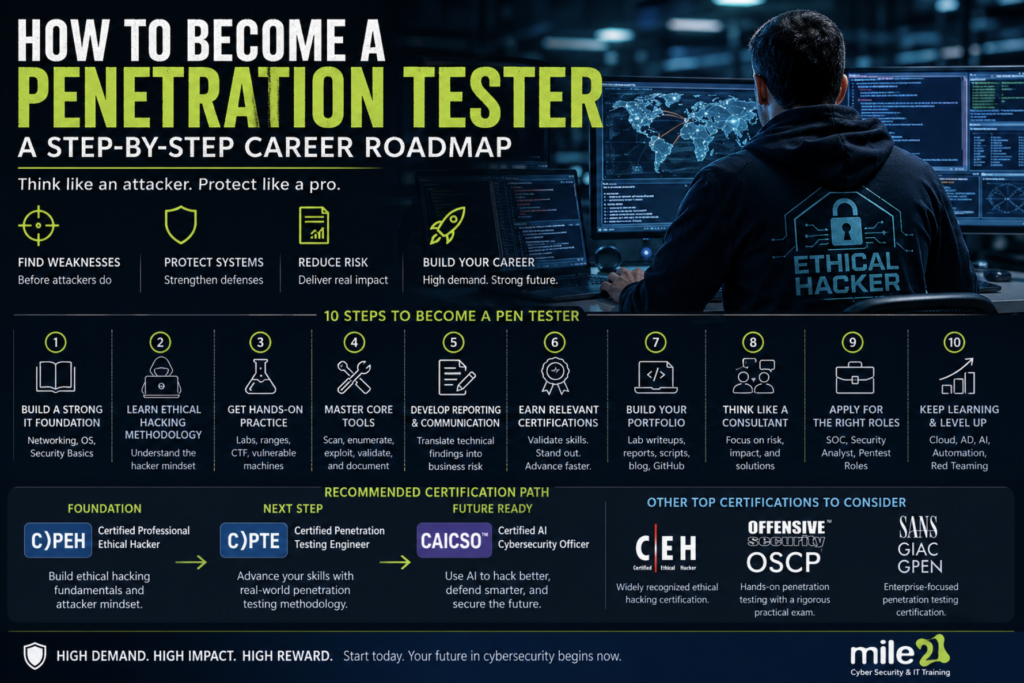
Step 1: Build a Strong IT Foundation
Before learning exploitation techniques, you need to understand the systems you will be testing. Penetration testing is much easier when you already understand networking, operating systems, identity, web applications, and basic security concepts.
Start with these core areas:
- Networking fundamentals, including TCP/IP, DNS, routing, ports, protocols, VPNs, firewalls, and packet flow.
- Operating systems, especially Windows, Linux, and basic command-line administration.
- Security fundamentals, including authentication, access control, encryption, patching, logging, and vulnerability management.
- Web technologies, including HTTP, HTTPS, cookies, sessions, APIs, databases, JavaScript, and common web application architectures.
- Cloud basics, including AWS, Azure, Google Cloud, identity models, storage, virtual networking, and shared responsibility.
A future pentester does not need to become a senior network engineer, system administrator, cloud architect, and developer before starting. However, the more you understand how technology is built and operated, the better you will be at finding meaningful weaknesses.
Step 2: Learn Ethical Hacking Methodology
A professional pentest follows a methodology. This is what separates real penetration testing from random tool use.
A typical ethical hacking process includes:
- Pre-engagement planning
- Scoping and rules of engagement
- Reconnaissance
- Scanning and enumeration
- Vulnerability analysis
- Exploitation validation
- Post-exploitation analysis
- Reporting
- Remediation support
- Retesting
This is where many beginners make a mistake. They jump directly into tools without learning how to define scope, protect evidence, avoid disruption, document findings, and explain business risk.
A professional pentester must know what is authorized, what is out of scope, how far testing can go, and when to stop. The ability to operate safely and professionally is just as important as technical capability.
Step 3: Get Hands-On Practice in Legal Lab Environments
Penetration testing is a practical skill. Reading about ethical hacking is useful, but you must practice in controlled environments.
Beginners should use legal labs, cyber ranges, vulnerable virtual machines, CTF-style environments, and structured training platforms. The goal is to develop a repeatable process, not simply memorize commands.
Good practice areas include:
- Scanning a lab network and identifying live hosts
- Enumerating open ports and services
- Researching vulnerabilities safely
- Testing weak credentials in a lab
- Practicing Linux and Windows privilege escalation
- Testing web vulnerabilities in intentionally vulnerable apps
- Writing professional findings with evidence and remediation steps
You should never test systems that you do not own or do not have written permission to assess. Unauthorized testing can be illegal, even if your intent is educational.
Step 4: Learn the Core Tools of the Trade
Tools do not make someone a pentester, but every pentester needs tool fluency. The key is knowing what a tool does, when to use it, how to interpret results, and how to validate findings manually.
Common tool categories include:
- Network scanning tools
- Web application testing tools
- Password auditing tools
- Directory and subdomain discovery tools
- Exploitation frameworks used in labs and authorized tests
- Proxy tools for web traffic analysis
- Cloud and Active Directory assessment tools
- Reporting and evidence management tools
Students should avoid becoming dependent on automated scanners. Automated tools can miss vulnerabilities, produce false positives, or misunderstand business context. A strong pentester uses tools to accelerate testing, then applies judgment to confirm whether a weakness is real, exploitable, and meaningful.
Step 5: Develop Reporting and Communication Skills
Many new pentesters focus almost entirely on exploitation. In the real world, reporting is one of the most important parts of the job.
A penetration test report should explain:
- What was tested
- What was found
- How severe the issue is
- How the issue could affect the business
- What evidence supports the finding
- How the organization should fix it
- What should be prioritized first
A technical finding is only useful if the organization can understand it and act on it. Executives need business risk. System administrators need technical detail. Developers need clear remediation guidance. Compliance teams may need evidence tied to controls or regulatory expectations.
The pentester’s job is not finished when a shell is obtained or a vulnerability is confirmed. The job is finished when the risk is clearly communicated and the organization understands what to do next.
Step 6: Choose the Right Penetration Testing Certifications
Certifications can help structure your learning, validate your skills, and show employers that you are serious about the field. The best certification path depends on your current experience level and career goal.
Below is a practical certification roadmap.
Beginner to Intermediate: Mile2® C)PEH
The Mile2® Certified Professional Ethical Hacker, or C)PEH, is a strong starting point for learners who want to understand ethical hacking methodology, attacker thinking, and practical security testing concepts. Mile2® describes C)PEH as foundational training in its penetration testing certification line, designed to help professionals protect systems by seeing them through the eyes of a hacker.
C)PEH is a good fit for:
- New cybersecurity professionals
- IT administrators moving into security
- Help desk or network support professionals
- Students preparing for hands-on security roles
- Professionals who want ethical hacking fundamentals before advanced pentesting
The value of C)PEH is that it helps learners build the foundation before moving into deeper exploitation, post-exploitation, and enterprise penetration testing.
Intermediate to Advanced: Mile2® C)PTE
The Mile2® Certified Penetration Testing Engineer, or C)PTE, is designed for professionals who want to move beyond introductory ethical hacking and into more complete penetration testing workflows. It is a strong fit for learners who want to understand how reconnaissance, exploitation, post-exploitation, reporting, and business risk connect together.
C)PTE is especially relevant for:
- Aspiring penetration testers
- Security analysts moving into offensive security
- System administrators with security responsibilities
- Cyber range learners who want hands-on testing experience
- Professionals preparing for real-world pentest engagements
For a Mile2® career path, C)PEH can serve as the foundation, while C)PTE becomes the next step toward professional penetration testing capability.
AI-Enhanced Security and Offensive Thinking: Mile2® CAICSO™
The role of the penetration tester is changing because artificial intelligence is changing how attackers and defenders operate. AI can help with reconnaissance, scripting, phishing analysis, vulnerability research, report generation, and security automation. At the same time, AI systems themselves introduce new risks, including prompt injection, data leakage, insecure tool use, model abuse, and unsafe autonomous execution.
The Mile2® Certified AI Cybersecurity Officer, or CAICSO™, is positioned around securing AI systems, managing AI cybersecurity risk, and helping organizations build secure, ethical, and auditable AI ecosystems. Mile2® describes CAICSO™ as focused on AI cybersecurity protection and governance, including the secure and responsible use of AI in cybersecurity programs.
For future pentesters, CAICSO™ can be valuable because the next generation of offensive security will increasingly involve AI-assisted testing and AI-targeted security assessments. A modern pentester should understand not only how to use AI responsibly, but also how AI systems can be attacked, abused, or misconfigured.
CAICSO™ is a strong addition for:
- Pentesters who want to understand AI-enabled cyber risk
- Security leaders responsible for AI governance
- Red teamers exploring AI-assisted workflows
- Professionals testing applications that integrate AI agents or large language models
- Organizations preparing for AI security assessments
Other Industry Certifications to Consider
A strong article should acknowledge the broader certification ecosystem. Many learners compare Mile2® certifications with well-known alternatives, and it is helpful to position them honestly.
CEH
The Certified Ethical Hacker, or CEH, from EC-Council is one of the most recognized ethical hacking certifications. EC-Council describes CEH AI as a certification that teaches hacking concepts and how to think like a hacker in the age of AI. CEH can be useful for learners who want a widely recognized credential, especially in organizations that list it in job descriptions.
Offensive Security OSCP
The Offensive Security Certified Professional, or OSCP, is widely known for its hands-on penetration testing exam and practical reputation. It is often associated with learners who want to prove they can apply technical exploitation skills under pressure. SANS also lists OSCP among relevant penetration testing certifications. OSCP is often best pursued after a learner has built solid networking, Linux, Windows, web, and exploitation fundamentals.
SANS / GIAC GPEN
The GIAC Penetration Tester, or GPEN, is commonly aligned with SANS penetration testing training. SANS describes SEC560 as an enterprise penetration testing course focused on identifying, exploiting, and assessing real business risk across environments such as on-premises systems, Azure, and Entra ID. GPEN is a strong option for professionals who want structured, enterprise-focused penetration testing training.
Recommended Certification Path
For many learners, the path can look like this:
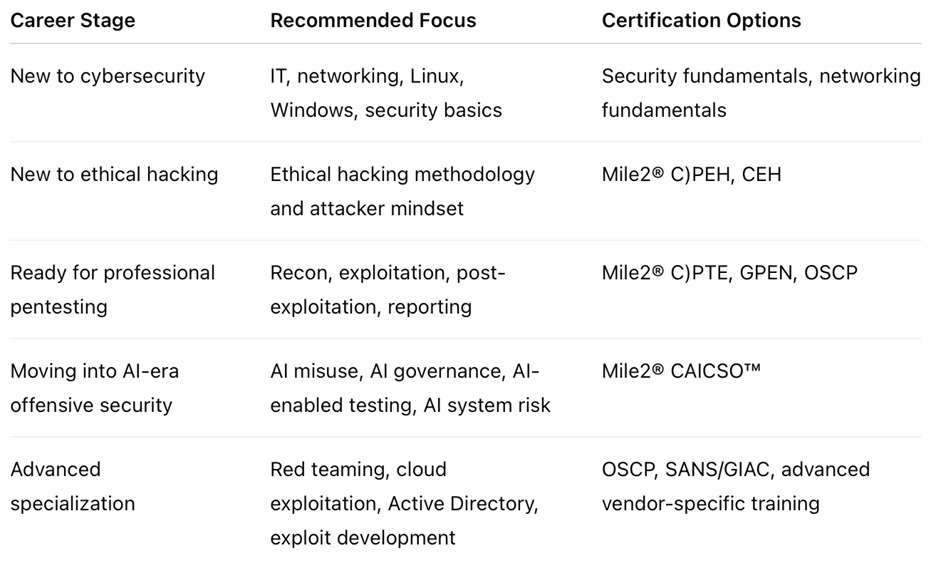
For Mile2® students, the clearest path is:
C)PEH → C)PTE → CAICSO™
C)PEH builds the ethical hacking foundation. C)PTE develops deeper penetration testing capability. CAICSO™ helps prepare learners for the AI-driven future of cybersecurity, where both attackers and defenders are using AI more aggressively.
Step 7: Build a Portfolio
Employers want evidence that you can do the work. A portfolio can help you stand out, especially if you are trying to move from IT support, networking, systems administration, or school into a pentesting role.
A good beginner portfolio may include:
- Lab write-ups from legal environments
- Sample penetration test reports
- A GitHub repository with safe scripts or notes
- Blog posts explaining security concepts
- Documented CTF or cyber range lessons learned
- A home lab architecture diagram
- A vulnerability analysis write-up using intentionally vulnerable systems
*Do not publish exploit code, stolen data, real client findings, or anything that violates a platform’s rules. Keep your portfolio professional and safe.
Step 8: Learn How to Think Like a Consultant
A pentester is often a consultant, even when employed internally. That means your job is not just to find vulnerabilities. Your job is to help the organization make better security decisions.
A professional pentester asks:
- What business process does this system support?
- What data is at risk?
- Could this weakness lead to privilege escalation?
- Could an attacker move laterally from here?
- Is this finding exploitable in the real environment?
- What is the realistic business impact?
- What remediation is practical for this organization?
- What should be fixed first?
This mindset separates a junior tool user from a professional penetration tester.
Step 9: Apply for the Right Entry-Level Roles
Not everyone becomes a pentester as their first cybersecurity job. Many professionals build toward penetration testing through related roles.
Good stepping-stone roles include:
- Security analyst
- SOC analyst
- Network administrator
- System administrator
- Cloud support engineer
- Vulnerability management analyst
- Application security analyst
- IT support specialist with security responsibilities
- Cybersecurity consultant
The NICE Framework provides a common language for cybersecurity workforce roles, tasks, knowledge, and skills, helping employers, educators, and learners describe cybersecurity work more consistently. This matters because “penetration tester” job titles can vary. Some organizations may call the role security consultant, offensive security analyst, red team operator, application security tester, or vulnerability assessment specialist.
Step 10: Keep Learning Because the Field Changes Constantly
Penetration testing evolves quickly. New cloud services, AI tools, identity systems, SaaS platforms, APIs, containers, and endpoint defenses change the way testing is performed.
A modern pentester should continue learning:
- Cloud penetration testing
- Active Directory and identity attacks
- Web application and API security
- Container and Kubernetes security
- AI security and prompt injection risks
- Scripting with Python, PowerShell, or Bash
- Detection-aware testing and purple teaming
- Professional reporting and risk communication
The best pentesters are lifelong learners. They do not simply memorize techniques. They understand systems, adapt to new environments, and keep improving their methodology.
How Long Does It Take to Become a Penetration Tester?
- The timeline depends on your starting point.
- Someone already working in IT may be able to move toward junior penetration testing in 6 to 12 months with focused study, labs, and certifications.
- Someone starting from zero may need 12 to 24 months to build networking, operating system, security, and ethical hacking skills.
- Someone aiming for advanced penetration testing, red teaming, cloud exploitation, or AI-assisted offensive security should expect a longer path of continuous development.
- The goal is not to rush. The goal is to become competent, ethical, and employable.
Final Roadmap: How to Become a Pen tester
Here is the practical roadmap:
- Learn networking, operating systems, and security fundamentals.
- Study ethical hacking methodology and legal boundaries.
- Practice in legal labs and cyber ranges.
- Learn core pen testing tools, but do not rely on tools alone.
- Build web, cloud, Linux, Windows, and identity security knowledge.
- Earn a foundational certification such as Mile2® C)PEH or CEH.
- Advance into professional pen testing with Mile2® C)PTE, GPEN, or OSCP.
- Build a portfolio of lab reports and safe technical write-ups.
- Learn how to communicate findings clearly to technical and business audiences.
- Add AI cybersecurity knowledge through CAICSO™ to prepare for the next generation of offensive and defensive security work.
Conclusion
Becoming a penetration tester is one of the most rewarding paths in cybersecurity, but it requires more than curiosity and tools. It requires discipline, ethics, hands-on practice, technical depth, and the ability to explain risk clearly.
For learners who want a structured path, Mile2® offers a practical progression:
C)PEH for ethical hacking foundations
C)PTE for professional penetration testing development
CAICSO™ for AI-era cybersecurity, AI governance, and understanding how AI is changing both attack and defense
The future of penetration testing will not be limited to traditional networks and web applications. It will include cloud platforms, identity systems, APIs, automation, AI agents, and AI-assisted attacks. Professionals who prepare now will be better positioned for the next generation of cybersecurity careers.
References
Bureau of Labor Statistics. (2025). Information security analysts: Occupational Outlook Handbook. U.S. Department of Labor.
CISA. (2026). NICE Workforce Framework for Cybersecurity. National Initiative for Cybersecurity Careers and Studies.
EC-Council. (2026). Certified Ethical Hacker CEH AI.
Mile2® Cybersecurity Institute. (2026). C)PEH Course Outline.
Mile2® Cybersecurity Institute. (2026). CAICSO™ Course Outline.
Mile2® Cybersecurity Institute. (2026). C)AICSO: Certified AI Cybersecurity Officer.
SANS Institute. (2026). SEC560: Enterprise Penetration Testing.
SANS Institute. (2026). Penetration Tester Certifications.