

The Silent Crisis in AI Cybersecurity
By Dr. Raymmond Friedman – November 24, 2025
The Silent Crisis in AI Cybersecurity:
How Leadership Failures Are Now the #1 Organizational Risk
Artificial Intelligence is now embedded in everything — cybersecurity tooling, enterprise automation, public-sector systems, and even strategic decision-making. But while organizations are accelerating AI adoption, a dangerous truth has emerged:
The single greatest threat in the AI age is not the attacker.
It’s the leader who fails to govern AI responsibly.
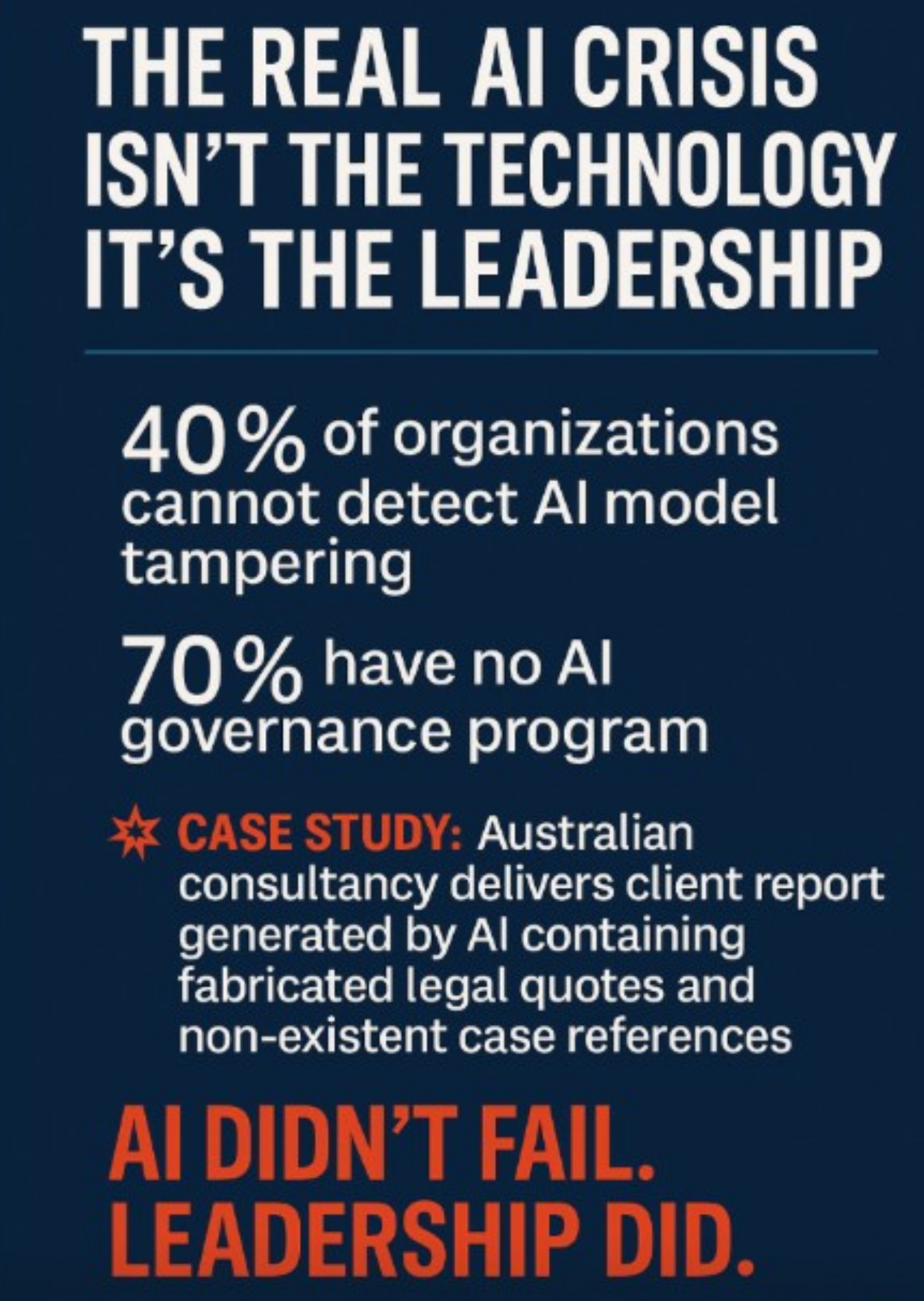
According to a 2025 analysis, 40% of organizations cannot detect model tampering, and nearly 70% lack formal AI governance to prevent data leakage, poisoning, or unauthorized model modification.
Yet, more then 60% of C-Suite leaders report “low urgency” for AI security adoption.
This gap between threat reality and leadership awareness is now a systemic weakness.
Case Study: When Leadership Ignores AI Governance, the System Breaks
A recent incident in Australia exposed the consequences of leadership negligence:
- A consultancy used Azure OpenAI to generate a client report.
- The AI hallucinated, fabricated legal quotes, false case references, and non-existent statutes.
- The report was delivered to the client, creating legal, reputational, and regulatory consequences.
Why did this happen?
Because the leadership team had no governance guardrails.
No validation workflow. No AI-output review policy. No ethical oversight. No transparency.
AI didn’t fail. Leadership failed.
The Cost of AI Misgovernance
When leadership fails to build maturity around AI usage, the consequences are tangible:
- The U.S. government’s Department of Government Efficiency (DOGE) claimed $160 billion in savings, but independent analysis estimated $135 billion in hidden costs from workforce disruption and process breakdown — a governance disaster.
- Gartner estimates that through 2026, 30% of AI breaches will stem from unmonitored model behavior and governance gaps.
- IBM reports the average cost of an AI-modified attack is 3.5× higher than a traditional cyberattack.
The formula is simple:
AI + No Governance = Catastrophic Risk.
Why Leadership Is the Fragile Point in the AI Era
- Speed Over Security
Executives rapidly deploy AI while treating security as an add-on. - Delegation Without Ownership
AI decisions are pushed to tech teams, but governance must originate with leadership. - Blind Spots in Ethical & Operational AI Risk
Many leaders lack training in AI ethics, bias, drift, or hallucination risk. - Lack of Accountability Structure
Most boards do not require AI risk reporting or lifecycle oversight. - 5. Cultural Immaturity
Organizations still treat AI as a productivity tool rather than a strategic risk surface.
Frameworks to Fix Leadership Failure (From my book “The Art of an Organizational Leader”)
Your book lays out principles that directly address these leadership failures.
1. The Principle of Foundational Integrity
AI security begins with leadership integrity — building governance before deployment.
2. The Accountability Structure Principle
Organizations must establish:
- Model owners
- Data stewards
- Validation authorities
- Reporting lines
A system without owners is a system destined to be exploited.
3. The Principle of Transparent Decision-Making
AI must be explainable — leaders should demand:
- Audit logs
- Drift detection
- Red-team results
- Output verification
Transparency eliminates systemic blindness.
4. Ethical Stewardship
Your book emphasizes values-driven leadership.
AI models should be trained and operated with:
- Ethical intent
- Bias mitigation
- Safety constraints
- Human oversight
- Ethics is not optional; it is a control.
5. Strategic Adaptability
Leaders must train continuously in:
- AI risk
- Data governance
- Algorithmic behavior
- Executive-level AI literacy
In the AI era, adaptability determines survival.
Conclusion: The Crisis Is Not AI — It’s Leadership
AI is not inherently dangerous. Poor leadership is.
Leaders who fail to implement governance, integrity, transparency, accountability, and adaptability will see their organizations fall victim to AI-driven risks.
Those who rise to the challenge will define the next generation of resilient, intelligent, and ethical enterprises.
About the Author
Dr. Raymond Friedman
Author of The Art of an Organizational Leader
Architect of Mile2’s Certified Organizational Leadership Program
President of Mile2®
➡️ Follow Dr. Raymond Friedman for insights on AI governance, cybersecurity leadership, and the evolving ethics of intelligent defense.